


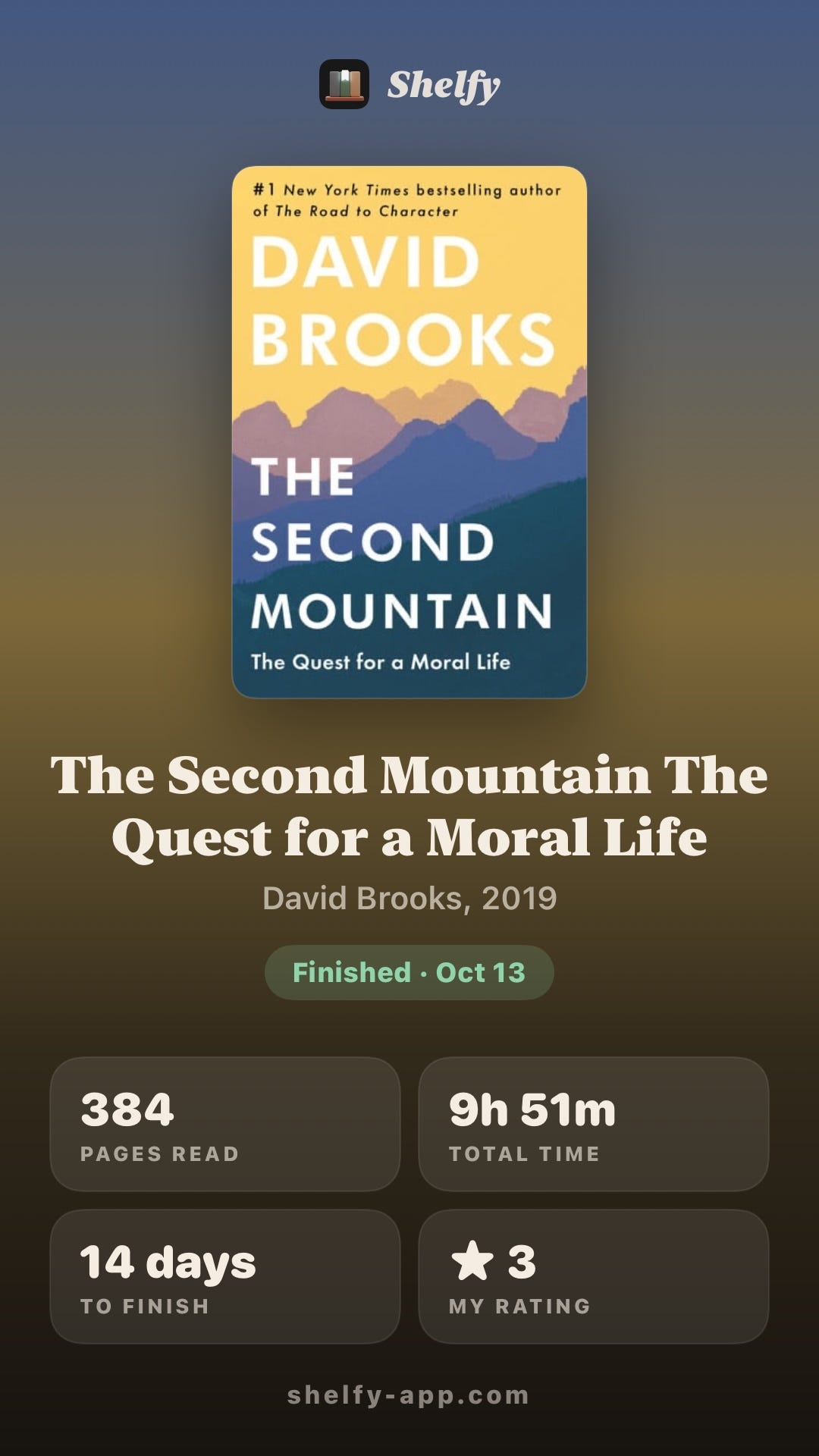
The View From the First Summit
For a long stretch of my career, I knew exactly what the next step was. There was always a bigger team to lead, a harder system to stabilize, a title that sounded slightly more important than the one I had. I wrote about that world for years at BradFromIT, and I meant every word of it. I still do, mostly.
But somewhere along the way the next step stopped being obvious, and the view from the top of the hill I had been climbing turned out to be less satisfying than the brochure promised. Nothing dramatic happened. No crisis, no burning platform. Just a quiet sense that I had been answering the wrong question very efficiently.
That is roughly the territory David Brooks walks into with The Second Mountain: The Quest for a Moral Life. I picked it up expecting a polished columnist’s take on meaning. What I got was something more uneven, more personal, and more useful than that.
Two Mountains and a Valley
Brooks’ central image is simple enough to fit on a coffee mug, which is probably part of why the book sold so well. The first mountain is the one our culture hands us: build a career, make a name, be happy on your own terms. It is about the self, and there is nothing wrong with it as far as it goes.
Then, for many people, comes the valley. Sometimes it is failure or grief. Sometimes it is success that turns out to be hollow. Either way, the old goals stop working, and a person is left with the choice of getting bitter or getting broken open.
The second mountain is what some people climb on the far side of that valley. Brooks describes it as a life organized around commitments rather than achievements, and he names four of them:
Vocation, work that answers a call rather than simply paying well
Marriage, or more broadly, a covenant with another person
Philosophy and faith, a settled sense of what you believe and why
Community, a place and a people you bind yourself to
The book is organized around those four, with long detours into the cultural argument underneath them. Brooks thinks a half century of what he calls hyper-individualism has left us lonely and unmoored, and that the cure is not more self-actualization but more binding commitments. Freedom, in his telling, is a starting point rather than a destination.
What Rings True
The best thing about this book is that Brooks starts with a confession. He admits, early and without much cushioning, that he spent years being emotionally aloof, that his work came first, and that his first mountain looked impressive from the outside while things fell apart closer to home. That honesty buys him a lot of credit, because it means the rest of the book is not a lecture from someone who has it all figured out.
The distinction between happiness and joy is where he earns his keep. Happiness, as he frames it, is about the self getting what it wants. Joy is what shows up when the self is forgotten for a while, usually in service of someone or something else. I have felt both. The second kind tends to arrive at inconvenient hours, usually while I am doing something I did not particularly want to do for someone who will not remember it. That is about as close to proof as I need.
His section on vocation also landed harder than I expected. Brooks argues that a calling is less about finding your passion and more about noticing a problem that grabs you and will not let go. After twenty-some years in technology, I can say the parts of the work that still matter to me are not the ones on my resume. They are the people I helped get unstuck, and the systems I fixed so someone else could go home on time.
Finally, the community chapters are a useful corrective for anyone who spends most of their day on a screen. Brooks spends time with “weavers,” ordinary people quietly rebuilding social fabric in their towns, and those stories are the warmest part of the book. Anyone who has stood on the sideline of a youth soccer game in the cold, or sat through a board meeting about field schedules, will recognize the unglamorous work he is describing. It does not trend. It holds things together anyway.
Where It Stumbles
The book is long, and it feels longer than it is. Brooks is a generous reader, and he wants you to meet every thinker who ever helped him, so a good portion of the middle reads like a commonplace book with a thesis attached. Some of those quotations are wonderful. Several dozen of them could have stayed in the notebook.
The tidiness of the framework is also its weakness. Real lives rarely move in two clean ascents with a valley in between. Most people I know are climbing both mountains at once, on alternating weekdays, while also doing the dishes. Brooks acknowledges this in places, but the metaphor keeps pulling him back toward a neater story than the one most of us are living.
There is also the question of vantage point. This is a book written by a successful man at the top of a very visible first mountain, and some of its advice assumes a level of freedom many readers do not have. Choosing a vocation over a paycheck is easier when the paycheck has already been secured. To his credit, Brooks seems aware of this, but awareness does not quite close the gap.
And while the confession at the start is real, some readers have felt he moves past the end of his first marriage a little too quickly given how much of the book’s authority rests on his own transformation. I do not think that sinks the book. It does make the marriage chapter read more like theory than testimony.
The Quietest Chapter
The most surprising part of the book is the one where Brooks talks about his own faith. He was raised Jewish, spent years as what he calls a cheerful agnostic, and then found himself drawn toward Christianity without ever quite leaving where he started. He describes the experience less as an argument he won and more as a set of encounters that kept piling up until he could not explain them away.
What I appreciated is that he does not tie it up neatly. He calls himself a wandering Jew and a very confused Christian, and he seems content to let that tension stand. There is no altar call here, and no attempt to talk the reader into anything. It reads like a man reporting what happened to him and admitting he is still working out what it means.
That restraint is the right call. Faith shows up in this book the way it tends to show up in actual life, underneath everything else, shaping the other commitments rather than competing with them. Readers who share it will find a lot to sit with. Readers who do not will still find an honest account of what it looks like when someone stops treating belief as a hobby.
Should You Climb It?
The Second Mountain is not a perfect book. It is too long, a little too neat, and written from a comfortable altitude. But it asks the right question at the right volume, and it asks it of the author first.
If you are somewhere in the middle of a career and the next promotion has started to feel more like a chore than a goal, this book is worth your time. Read the first third closely, skim the middle without guilt, and slow down again for the chapters on faith and community. That is where Brooks stops building an argument and starts telling the truth.
I did not finish it with a plan. I finished it with a better question, which is usually more useful anyway. The first mountain asked what I could get. The second one keeps asking who I am for.
Verdict: Recommended, with a pencil in hand and permission to skip.
As You Find Me (AYFM) is where Brad Hachez - a visionary neurodivergent creator - explores tech, faith, health, & life. Join the journey to streamline productivity, deepen relationships, & reflect on purpose with resilience, presence, and servant-hearted growth.