


When the Lights Stayed On
There’s a moment in every home project when you realize:
“Oh. This is actually happening.”
For me, that moment wasn’t the order confirmation email, though that one did feel like a small rite of passage. It wasn’t even the installation date on the calendar. It was the morning I opened the garage door and saw two Tesla technicians standing there with quiet confidence, tool bags in hand, ready to turn my house into something a little more resilient than it was the day before.
The Powerwall installation process is surprisingly… human.
You expect robots. Or at least a drone.
Instead, you get two people who’ve done this a hundred times and still treat your home like it matters.
The Walkthrough
Every installation starts with the same ritual: the walkthrough.
They point at the main panel, the backup gateway and at the spot on the wall where the Powerwall will live.
And I nod (the universal homeowner nod) that says,
“Yes, of course, I too think about amperage and load balancing in my free time.” To be clear, I do not think about amperage and load balancing in my free time.
But beneath the nodding is something else: a quiet sense of stewardship.
This isn’t just a gadget. It’s infrastructure.
It’s the bones of your home getting a small upgrade in courage.
The Work
The installation itself is a kind of choreography:
The electricians shut off the power (the house exhales).
They mount the backup gateway a.k.a the brain of the operation.
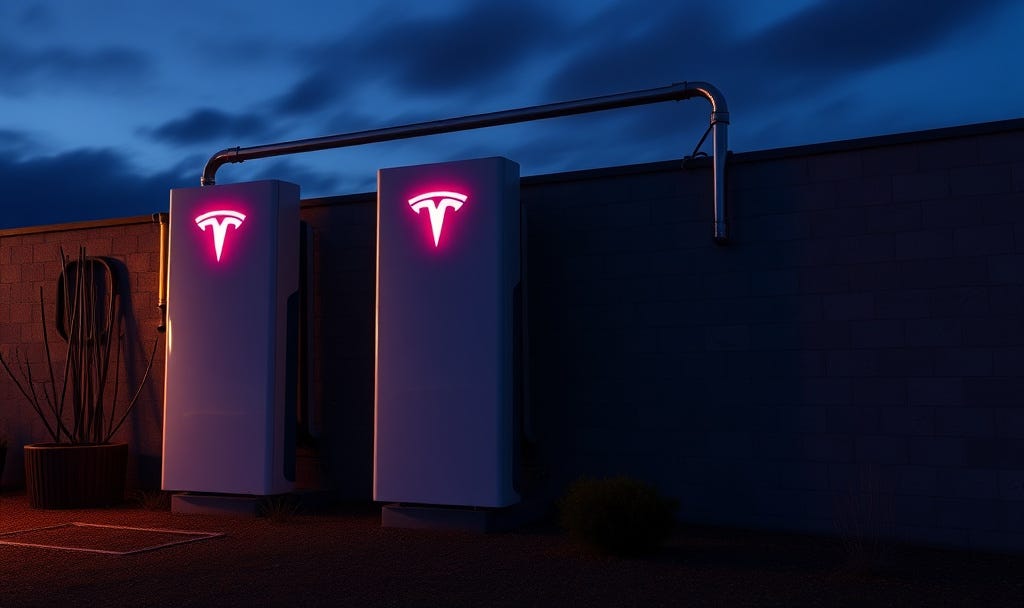
They bolt the Powerwalls to the wall like it’s a sacred artifact. Okay, there were 2 Powerwalls and a backup gateway.
They run conduit with the precision of people who know storms don’t negotiate.
They wire everything into the panel with a reverence I didn’t expect.
There’s a moment when the Powerwall is physically there but not yet alive like a heart waiting for its first beat.
And then they flip the breakers.
The system wakes up. The LEDs glow. The Tesla app refreshes and suddenly your home has a second heartbeat.
The App Setup
Once the system is commissioned, the app becomes your new favorite toy.
You watch the little animated lines:
solar → home
grid → Powerwall
Powerwall → home
It’s strangely meditative like watching a digital version of your house breathe.
And then you do the thing everyone does:
You run a backup test.
The technicians flip the main breaker.
The house goes dark for half a second; a blink.
And then everything comes back on, powered by the battery on your wall.
It’s a small miracle; A quiet one. The kind that makes you feel both grateful and slightly invincible.
Living With It
Here’s the part I didn’t expect:
The Powerwall changes the way you feel in your home.
Not dramatically. Not in a “prepper bunker” way. But in a grounded, steady, almost spiritual way.
There’s a comfort in knowing your home can hold its own.
That when the world flickers: storms, outages, the unpredictable. Your house doesn’t panic.
It just shifts, breathes, and keeps going.
It’s resilience you can see.
And resilience you can feel.

The Review
Was it worth it?
Yes — in the same way a good lock on your door is worth it.
Not because you expect disaster, but because you value peace.
Was the installation smooth?
Shockingly.
Tesla’s process is basically:
“We’ll handle everything, you just keep the garage semi‑clean.”
Does it change daily life?
More than I expected.
Not in big ways but in the subtle shift of knowing your home is a little more prepared than it was yesterday.
Would I do it again?
Absolutely.
In fact, I already catch myself thinking about the next Tesla tech.
This is how it starts.
The Real Takeaway
The Powerwall isn’t just a battery.
It’s a quiet promise.
A promise that your home can stay lit when the world goes dim.
A promise that preparation doesn’t have to be dramatic, it can be practical, thoughtful, even beautiful.
A promise that resilience is something you can build into the walls of your life.
And maybe that’s why this whole process feels bigger than an installation.
Because somewhere between the first email and the final commissioning, I realized I wasn’t just upgrading my house.
I was upgrading the way I think about caring for the people inside it.
One kilowatt-hour at a time.
As You Find Me (AYFM) is where Brad Hachez - a visionary neurodivergent creator - explores tech, faith, health, & life. Join the journey to streamline productivity, deepen relationships, & reflect on purpose with resilience, presence, and servant-hearted growth.