


“Spiritual people use religion to become better people. Fundamentalists use religion to pretend they’re better than other people.”

John Fugelsang’s The Separation of Church and Hate: A Sane Person’s Guide to Taking Back the Bible from Fundamentalists, Fascists, and Flock-Fleecing Frauds is part polemic, part pastoral care, and part stand-up sermon. Fugelsang, the son of a Catholic nun and a Franciscan brother, writes with the irreverence of George Carlin and the compassion of Anne Lamott. His mission: to reclaim Jesus from those who wield scripture as a cudgel rather than a balm.
“It’s not the miracles driving people away from religion, it’s the Christians who don’t live by Jesus’s words about how we’re supposed to treat each other.”
Highlights
Introduction: “This Book Is Not About You” – Fugelsang clarifies that his critique is aimed at Christian nationalists, not everyday believers. He sets the tone: sharp humor, but rooted in love.
“Thou Shalt Not Hate Feminists” – A chapter that reframes biblical women as exemplars of equality, countering centuries of distortion.
“Jesus’s Software Update” – Fugelsang describes the New Covenant as “Law 1.0 to Love 1.0,” a metaphor that resonates with anyone who’s ever updated their apps and realized the old system was clunky.
Case Studies in Misuse – From immigration to LGBTQ rights, Fugelsang shows how scripture is cherry-picked to justify exclusion, contrasting it with Jesus’s radical hospitality.
Closing Call to Action – A rallying cry for compassion, urging believers to reclaim their faith from political hijackers.
“Not only are Christians supposed to prioritize following Jesus’s words above the other parts of the Bible, that’s also quite literally why this religion got its name.”
Reading The Separation of Church and Hate doesn’t just sharpen my critique of Christian nationalism—it softens me toward the kind of faith I want to embody. Fugelsang’s words remind me that Christianity at its core is not about control, but about care. And that lands in the marrow of my own life, where ritual and play are my ways of resisting despair.
When Fugelsang talks about Jesus’s “software update,” I think of the Bear templates I design—structures that invite meaning rather than enforce it. Faith, too, is meant to be re-coded for love, not locked down by fear. His humor in exposing hypocrisy feels like my rituals with the kid: silly, yes, but also a reminder that joy itself is a form of resistance.
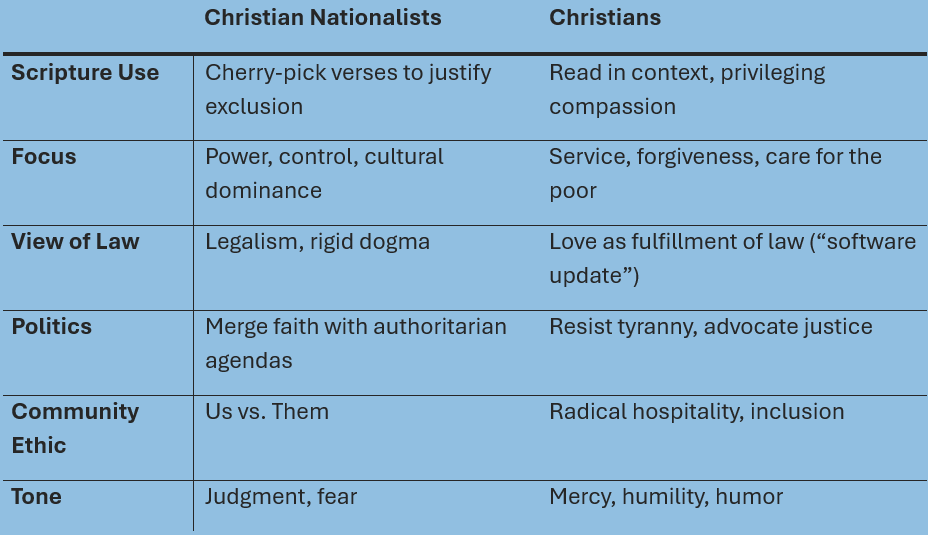
I’ve lived long enough to know that imperfection is the only constant. Fugelsang’s insistence that mercy is the true measure of faith feels like permission to keep walking in the “sacred middle” where life is neither triumphant nor tragic, but tender, human, and holy.
This book doesn’t just critique what’s broken; it invites me to live differently. To embody mercy in the way I parent, to choose forgiveness in the way I write, and to let humor be the thread that stitches together my rituals of resilience. In that sense, Fugelsang’s call is not abstract—it’s personal. It’s a reminder that the gospel is not about winning culture wars, but about washing feet.
And maybe that’s the truest ritual of all: to keep showing up with love, even when the world insists on hate.
You can visit John Fugelsang’s Substack:
